

You’re at a restaurant. Somewhere nearby, a kid has a YouTube video blasting at full volume. The parents don’t notice — or don’t care. Everyone else does.
It’s a scene that plays out in waiting rooms, on public transport, in cafés, and at family gatherings. And while it’s easy to chalk it up to “kids being kids,” the reality is that phone etiquette is a life skill — one most kids aren’t being taught.
This guide covers everything: when to use the phone, how to use it around others, how to speak and text respectfully, what the rules should look like at different ages, and why you — yes, you — are the most important factor in all of it.
Why Phone Etiquette Matters More Than Ever
51% of children aged 8 and under now have their own mobile device, and according to Common Sense Media, by age 14, 91% of kids have a phone. Meanwhile, the average teenager spends over 8 hours a day on their device.
Phones are not a teen problem anymore. They’re a childhood reality. Which means the window to build good habits is earlier than most parents think — and closes faster than they’d like.
The stakes aren’t trivial either. According to Pew Research, 42% of teens say smartphones make it harder to learn good social skills — and teens themselves are saying this. The habits kids form around their devices shape how they communicate, how they treat people around them, and how they present themselves in the world.
Part 1: Knowing When to Put the Phone Down
Before anything else, kids need to understand that a phone doesn’t have unlimited access to their attention. Context determines when it’s appropriate to be on a device — and when it isn’t.
Phone-free zones that should be non-negotiable:
- The dinner table. Family meals are one of the few daily moments for real conversation. Phones at the table — for kids or parents — kills it.
- Face-to-face conversations. If someone is talking to your child directly, they look up, respond, then return to the phone. Not the other way around.
- The first and last 30 minutes of the day. Mornings set the tone. Bedtime phone use is directly linked to poor sleep in children.
- Social gatherings. Parties, playdates, family events — if they’re physically present, they should be mentally present too.

When phones are fine:
- Downtime, in their room or a designated space
- Long journeys, when keeping to themselves isn’t antisocial
- Waiting situations where no one is engaging them
The key concept to teach: a phone is a tool you pick up and put down, not a permanent extension of your hand.
Part 2: Volume and Audio in Public
According to Pew Research, 79% of adults say they encounter loud or annoying phone behaviour in public at least occasionally, and 30% say it happens frequently. A significant chunk of that is kids — and often it’s not malicious; it’s just that no one told them.
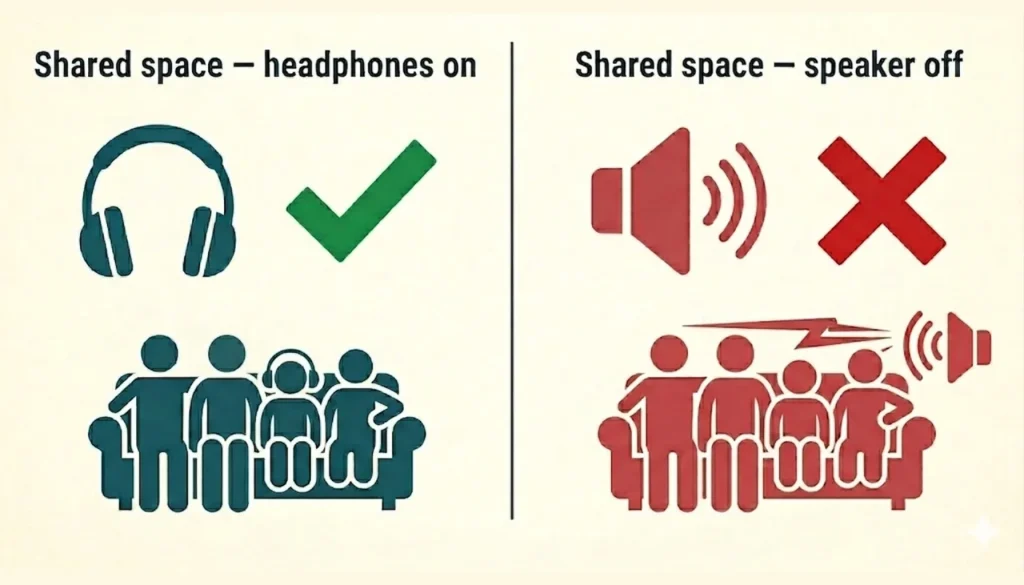
The rules are simple:
- Headphones for videos, games, and music. Always. In any shared space.
- Speaker calls in public are off-limits. Everyone nearby is now involuntarily part of the conversation.
- Ringtones on silent or vibrate in restaurants, waiting rooms, cinemas, and classrooms.
- Volume awareness — just because headphones are in doesn’t mean the volume is acceptable. If someone next to them can hear it, it’s too loud.
This is one of the most straightforward etiquette rules to enforce because it’s binary: headphones in, or phone down.
Part 3: Phone Call Etiquette
Calling is a skill that’s quietly disappearing — and kids who do use calls often do it badly. Teach these basics early:
Before the call:
- Check if it’s a good time to call (don’t ring someone during school hours or late at night)
- Know what you want to say before dialling
During the call:
- Greet the person by name. Start with “Hi, it’s [name].”
- Speak clearly, at a normal pace
- Don’t put people on speakerphone in public or in a room with other people without warning them
- Don’t have side conversations while on a call — it’s rude to both parties
- If you need to pause, say so: “Hold on one second.”
Ending the call:
- Don’t just hang up. Say goodbye.
- If it’s a wrong number, apologise before ending the call
These feel obvious to adults because they’ve had years of practice. Kids haven’t — they need to be shown, not just told.
Part 4: Texting and Messaging Manners
According to the American College of Pediatricians, teens aged 13–17 send an average of 3,364 texts per month — more than 100 a day for some. Texting is where most of kids’ communication actually happens, and most of the etiquette pitfalls live here.
- Response time expectations: Teach kids that they don’t have to respond instantly — but leaving someone completely unread for days is rude, especially if it’s someone who matters.
- Tone: Texts are stripped of tone, facial expression, and body language. What reads as casual to the sender can land as cold or hostile to the receiver. Teach kids to re-read before sending, especially in conflict situations.
- Group chats: Don’t flood a group with back-to-back messages, don’t add people without asking, and don’t screenshot and share private conversations.
- Autocorrect and abbreviations: Errors in messages to adults — teachers, relatives, parents of friends — can come across as careless. Teach kids to double-check before sending.
- What not to send: No personal information to people they don’t know well. No screenshots of others’ conversations shared without permission. No messages sent in anger — if they’re upset, wait.
Part 5: Social Situations — The Phubbing Problem
“Phubbing” — snubbing someone in person by looking at your phone — is now one of the most common sources of low-grade social friction in everyday life. And kids are both doing it and having it done to them constantly.
Research published in BMC Public Health found that 42% of adolescents experience occasional phone-related distraction during face-to-face conversations with parents, and 30% experience it frequently. If it’s that common with people they’re close to, imagine how often it happens with friends.
Teach kids:
- When someone is talking to you, you look at them — not the phone
- At a social event with friends, the phone stays in your pocket unless everyone’s using theirs
- Taking photos is fine; narrating your entire day to social media while you’re with people is not
- If you need to check your phone, acknowledge it: “Sorry, one second” — then actually put it away
Being fully present is a skill. It has to be practised.
Part 6: School and Classroom Etiquette
97% of teens say they use their phones during the school day — often when they’re not supposed to. This isn’t entirely a school problem. It reflects habits established at home.
Basic rules kids should know:
- Phones on silent during class — not just because teachers say so, but because it’s disrespectful to the people around you trying to learn
- Earbuds and headphones out when a teacher or adult is speaking
- Using a phone for notes or research is different from using it to scroll — kids should know the distinction and apply it honestly
- Never photograph or record someone at school without their knowledge
If your child’s school has a phone policy, enforce it at home too. Mixed messages don’t build principled behaviour.
Part 7: Age-by-Age Expectations
Etiquette isn’t one-size-fits-all. Here’s a rough framework by age group:
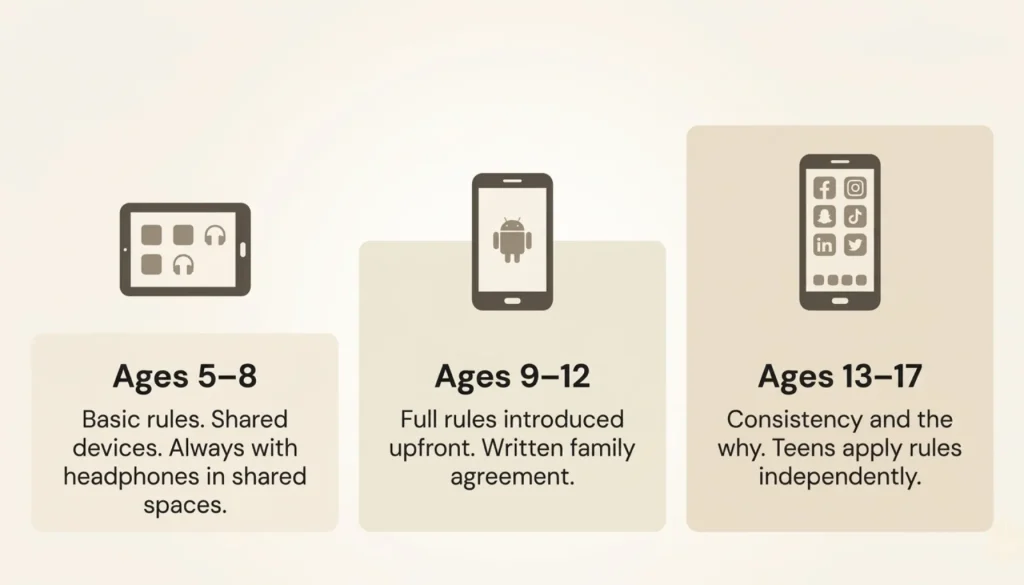
Ages 5–8: Foundation stage
At this age, kids are mostly using shared tablets or a parent’s phone. The job here is to establish the concept that devices are used at certain times, in certain places, and always with headphones when others are around. Keep it simple and consistent.
Ages 9–12: First device stage
Common Sense Media reports that 51% of children 8 and under already have a device, and this age group is getting their first personal phones. This is when the full set of rules needs to be introduced — not gradually, but upfront. Write them down together. Make expectations clear before handing over the device.
Ages 13–17: The high-stakes years
Social pressure peaks here. According to Pew Research, 44% of teens say they feel anxious when they don’t have their phone — which tells you how much of their social identity is tied to it. The goal isn’t to fight the phone, it’s to keep rules consistent and explain the why behind them. Teens who understand the reasoning are more likely to apply it independently.
Part 8: You Are the Model
This is the part most parent guides tiptoe around.
Pew Research found that 68% of parents say they are at least sometimes distracted by their own phone when spending time with their children. And a study from UC Santa Barbara found that parental phone use in front of children was the only media-related behaviour linked to lower child emotional intelligence.
Kids don’t do what you tell them. They do what they see you do.
If your phone is on the dinner table, theirs will be too. If you take calls on speaker in public, so will they. If you scroll while they’re talking to you, expect to watch them do the same to their friends.
According to Pew Research’s 2025 survey, about two-thirds of parents admit they spend too much time on their smartphone. Acknowledging that — out loud, to your kids — is actually a powerful teaching moment. “I’m working on this too” is more credible than “do as I say.”
Putting It Into Practice: Make a Family Phone Agreement
The most effective way to make these rules stick isn’t a lecture — it’s a conversation that ends with written, agreed-upon guidelines. Sit down as a family and work out:
- Which rooms or situations are phone-free
- What the volume rules are in shared spaces
- Expectations around responding to messages
- What happens if the rules aren’t followed
When kids have a say in setting the rules, they’re more likely to respect them. And when rules apply to adults at the table too, there’s no double standard to push back on.
One Tool That Makes the Volume Rule Automatic
Teaching is the most important piece — but enforcement helps. One area where parents consistently struggle is volume in public: the same reminder over and over, the same negotiation, the same “just this once.”
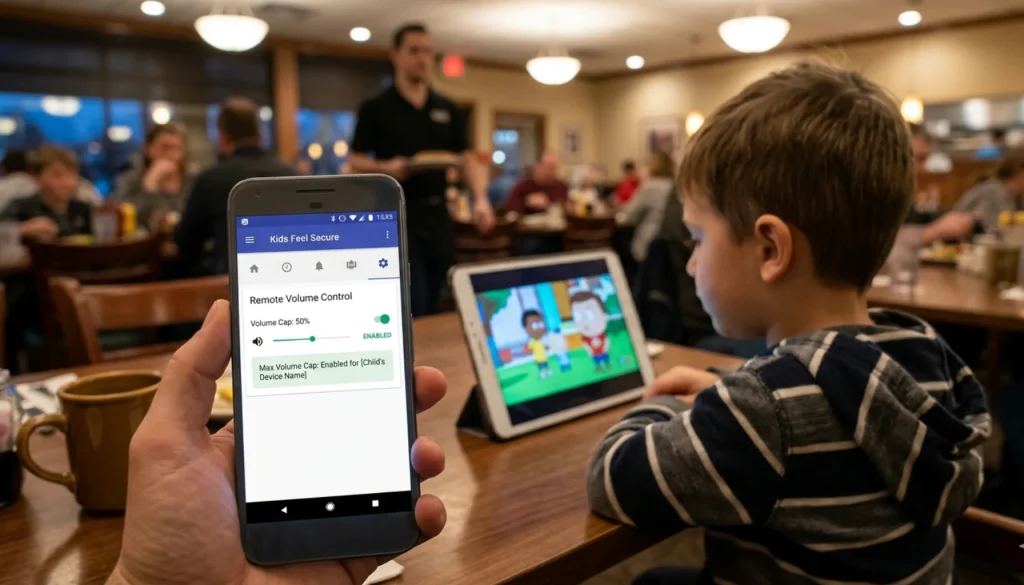
Kids Feel Secure — Volume Control removes the negotiation entirely. It lets parents set hard limits on a child’s device speaker volume, so the rule is built into the device itself — no arguments, no confiscating the phone, no repeating yourself in a restaurant.
But it’s designed with the bigger picture in mind. Volume Control pairs those limits with in-app guidance that helps kids understand why the rule exists — nudging them toward awareness and self-regulation, not just compliance.
Because the goal isn’t a kid who can’t turn their volume up. It’s a kid who doesn’t want to.
Leave a Reply