
Key Takeaways
• The average child’s brain is not equipped to self-regulate sensory input from screens — loud media isn’t a preference, it’s a developmental pull.
• Overstimulation from loud devices is linked to elevated stress hormones and arousal, plus shorter attention spans and disrupted sleep — even when the noise feels normal to the child.
• According to the World Health Organization, over 1 billion young people are at risk of permanent hearing damage from unsafe listening. Speakers, not just headphones, are a major contributor.
• Parental limits — set early and consistently — are the most effective intervention. Kids Feel Secure — Volume Control gives parents a practical, remote way to enforce those limits without a daily argument.
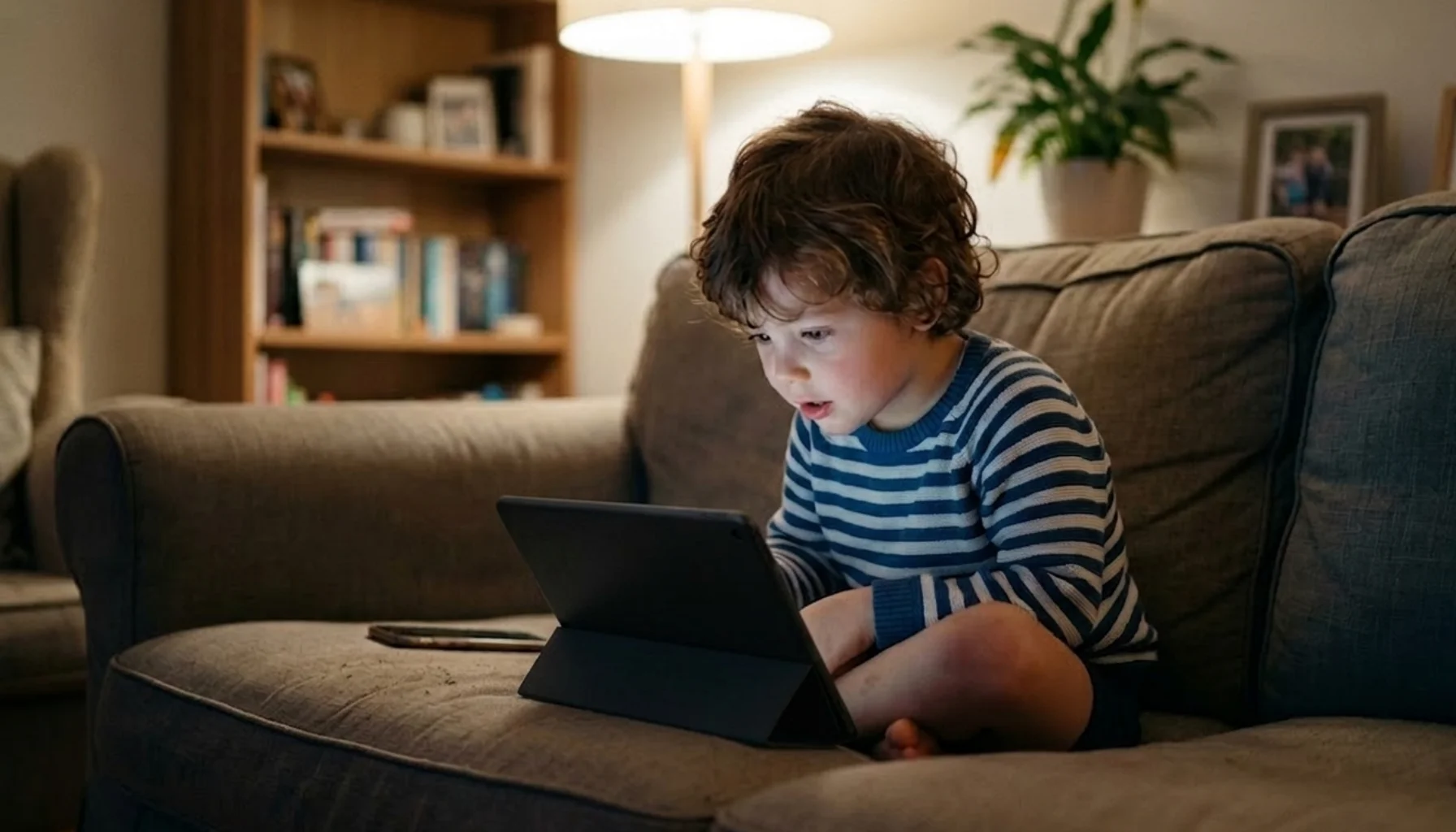
There’s a version of this that happens in nearly every home with young kids. The tablet comes out. Within minutes, the volume is at full blast. A cartoon character shrieks. A game plays its victory fanfare. A YouTuber yells. And your child is completely absorbed, face inches from the screen, completely unbothered by the noise that is slowly filling the room.
Most parents file this under “kids being kids.” But the research tells a more complicated story. The problem isn’t just that loud media is annoying. It’s that children’s developing brains are uniquely susceptible to the effects of overstimulation — and loud devices are one of the most pervasive, least discussed sources of it.
Here’s what’s actually happening, why it matters more than most parents realize, and what you can do about it.
The Developing Brain and Loud Stimulation
Children’s brains are not smaller versions of adult brains. They are structurally and functionally different in ways that make them far more reactive to sensory input — including sound.
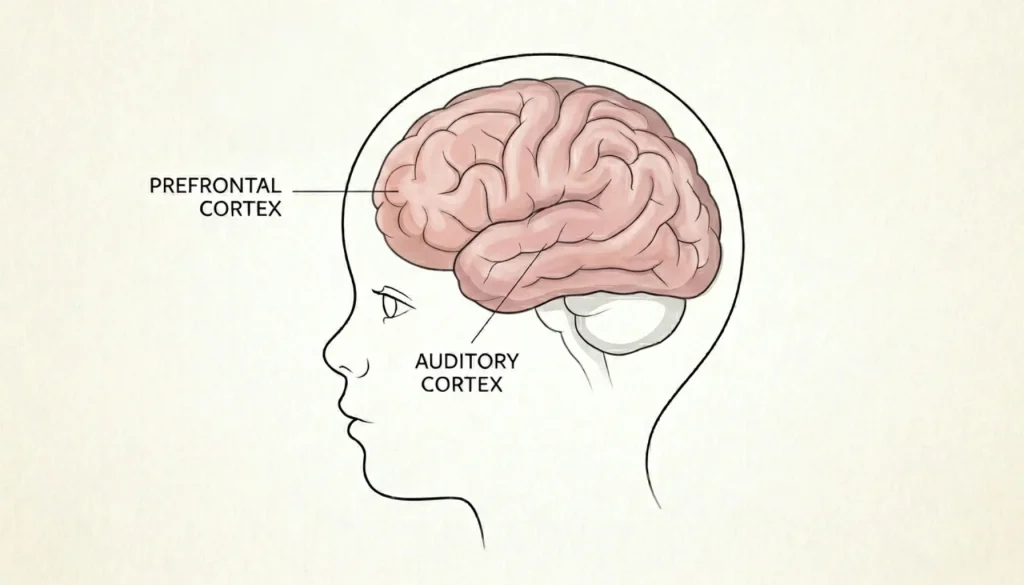
The prefrontal cortex — the part of the brain responsible for regulating impulses, moderating emotions, and making considered decisions — doesn’t fully mature until the mid-twenties. This means that when a child encounters stimulating media, they have a very limited capacity to consciously moderate their own response to it. Loud, fast-paced content bypasses their still-developing regulatory systems and delivers a direct hit of dopamine: the brain’s reward chemical.
Volume is part of that stimulation equation.
Research published in the journal Neuroscience & Biobehavioral Reviews highlights dopamine’s role in arousal and reward-seeking behavior. Research shows that high-intensity sensory input — including loud audio — activates the brain’s arousal systems in ways that feel rewarding in the short term but can impair attention and self-regulation over time. The louder it is, the more “awake” and engaged the child’s brain feels. This is why kids turn up the volume on their devices — and it has nothing to do with defiance.
There’s also a signal-to-noise problem that’s unique to children. A study from Aalto University found that background noise significantly impairs children’s ability to concentrate and process speech, far more than it affects adults. In a household full of ambient sounds, a child’s instinctive solution is to turn up the volume on whatever they’re watching. It’s not defiance. It’s a workaround for an immature auditory system that hasn’t yet learned to filter noise.
What Overstimulation Actually Does to Kids
The word “overstimulation” gets used loosely. What does it actually mean for a child’s body and brain when loud media is a daily constant?
Stress hormone activation. Loud, unexpected, or continuous noise triggers the release of cortisol — the body’s primary stress hormone. In adults, this response is generally mild and short-lived. In children, whose stress regulation systems are still forming, elevated cortisol from chronic noise exposure can be more sustained and harder to come down from. This shows up as irritability, difficulty transitioning between activities, and trouble settling at bedtime — all familiar to any parent whose child has spent a few hours with a blaring tablet.
Attention and concentration. A growing body of research links chronic sensory overstimulation in early childhood to shorter attention spans. A 2019 study published in JAMA Pediatrics found that higher screen time in preschool-aged children was associated with lower structural integrity in brain white matter tracts supporting language and executive function, as well as lower scores on corresponding cognitive assessments. Volume is part of the stimulation profile of content — louder is, by definition, more stimulating.
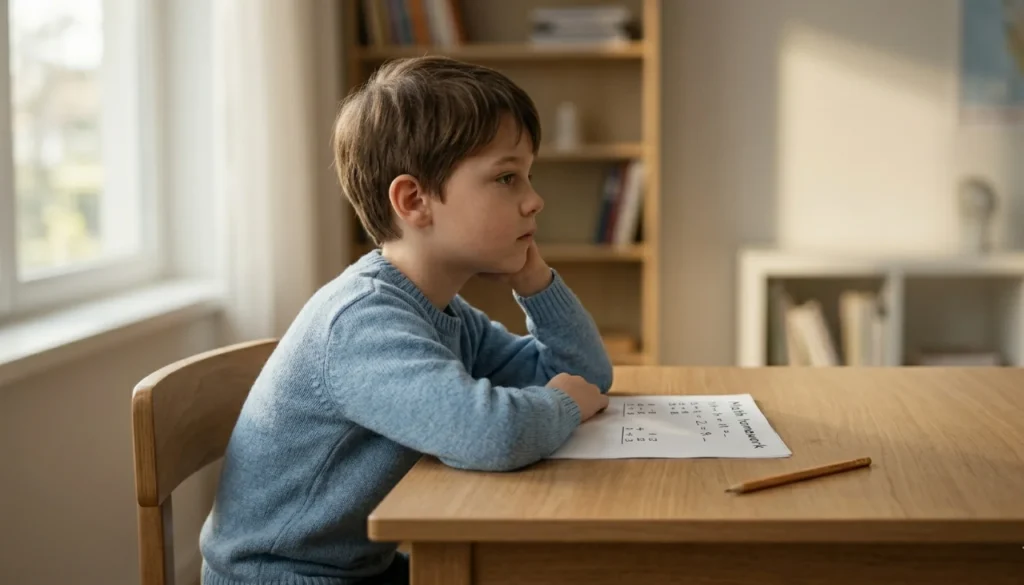
Sleep disruption. Loud, stimulating media before bed — even when the device is eventually put down — keeps the brain in a state of elevated arousal that takes time to unwind. Research from the National Sleep Foundation consistently links screen time close to bedtime with later sleep onset and poorer sleep quality in children, particularly when that content is fast-paced or loud. The volume isn’t incidental. It’s part of why the brain struggles to transition out of activation mode.
What makes this particularly tricky is that the child doesn’t feel any of this as a problem in the moment. The loud video is fun. The game is exciting. The stimulation feels good, by design. The costs show up later — in mood, in concentration, in sleep — in ways that parents often don’t connect back to the device volume. If you work from home, those costs extend beyond your child’s room — blaring tablets are one of the most common focus-killers for parents trying to get things done nearby.
The Hearing Risk That’s Easy to Miss
Overstimulation isn’t the only concern. There’s a hearing damage dimension to this that’s equally well-established and equally underappreciated by parents.
The World Health Organization estimates that over 1 billion young people are currently at risk of permanent, avoidable hearing loss from unsafe listening. That’s not a projected future risk. It’s the current situation. And while headphones and earbuds are often the focus of this conversation, device speakers carry their own significant risk.
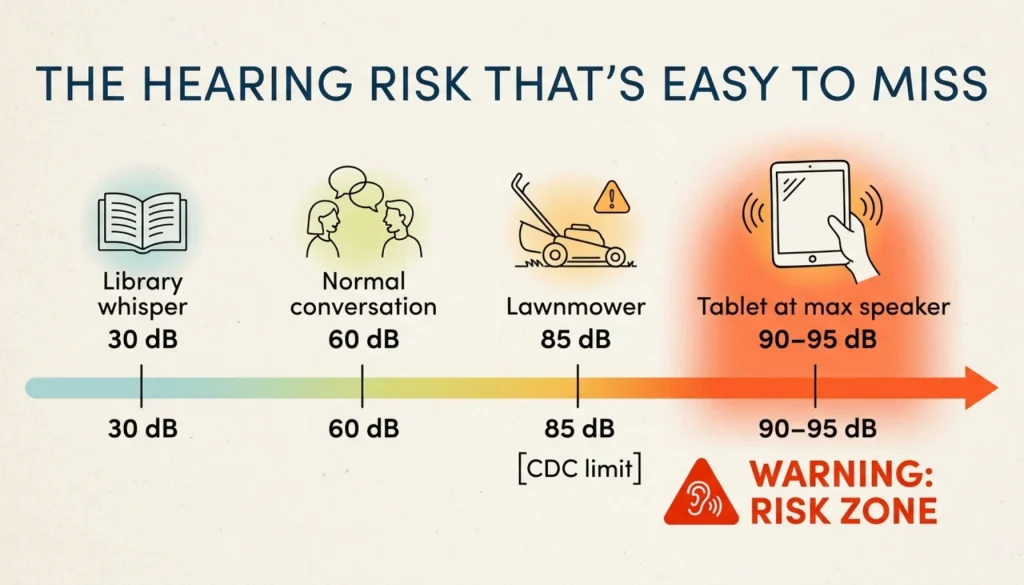
A tablet or phone at maximum speaker volume can push past 90–95 decibels. Sustained exposure above 85 dB — the CDC’s recommended ceiling — causes cumulative damage to the tiny hair cells inside the inner ear that convert sound waves into signals the brain can process. Those cells do not regenerate. Once damaged, the loss is permanent. And it doesn’t hurt. There’s no warning, no pain, no obvious signal in the moment that anything is wrong.
According to the CDC, 12.5% of children aged 6–19 already have measurable, permanent noise-induced hearing damage. One in eight. Most of that damage is preventable. Most parents don’t know it’s happening.
The speaker context makes this even more relevant: children using speakers tend to maintain loud volume for longer sessions than those using headphones. With headphones, at least there’s a chance someone walking by notices the sound leaking out. With a speaker playing through a closed bedroom door, the exposure can continue undetected for hours.
Why This Stays Under the Radar
Volume sits in an odd blind spot in the parenting conversation. Screen time, content appropriateness, and social media age limits get significant attention. The actual volume at which media plays gets almost none, despite the fact that it’s directly connected to hearing damage, stress response, and attentional load.
Part of the reason is that loud is normalized. Content creators, particularly on platforms aimed at children, have learned that high-energy, loud, fast-paced formats perform better. Algorithms reward engagement, and engagement is higher when stimulation is higher. The result is a category of child-targeted content that is, by design, optimized for maximum arousal.

Another reason is delayed feedback. The effects of regular overstimulation — inattention, mood dysregulation, poor sleep — don’t show up immediately after a single loud session. They accumulate. By the time the pattern is visible, the habit is already formed.
And practically speaking, native device controls don’t help. Limiting volume on Android for kids through native settings only works when headphones are connected, not for the built-in speaker. Family Link doesn’t include volume controls at all. iPhone’s Screen Time settings have volume limit options, but they’re hidden and require the device to be in hand to adjust. Parents who’ve gone looking for a straightforward way to cap speaker volume have generally come up empty.
The Habit Problem: Why Defaults Drift Upward
Volume isn’t just a hearing and overstimulation issue. It’s a device habit issue with long-term implications.
When children learn early that louder equals more engaging, it shapes how they interact with technology across the board. They become desensitized to moderate volume. They default to maximum. They resist being turned down because anything less feels like something is missing.
This mirrors patterns we see in screen time and notification behavior: without guardrails set during the formative years, defaults drift upward. A six-year-old who has always watched at full volume becomes a twelve-year-old who genuinely can’t understand why anyone would choose a lower setting. The habit is invisible because it was never interrupted.
Research on digital habit formation in children is consistent on this point: the earlier structure is introduced, the more likely children are to internalize it as normal rather than experience it as a restriction. Teaching phone responsibility early shapes far more than just volume habits — it builds the self-regulation skills that carry into how kids manage screens, social media, and digital distraction for years to come.
What Parents Can Do
The good news is that this is a genuinely solvable problem — especially if you act before the habit is fully embedded.

Talk about it with context, not just rules. Children respond better to reasons than commands. Explaining that loud sounds can permanently damage the tiny parts inside their ears — parts that don’t grow back — gives the rule a foundation. It won’t always work in the moment, but it builds toward the internal understanding that eventually produces self-regulation.
Model appropriate volume yourself. Children are observational learners. If the household default is loud TV, loud calls, loud everything, that’s the normal they’re absorbing. Quieter ambient environments give them a different reference point for what normal actually sounds like.
Set up designated quiet times. Meals, homework periods, and the hour before bed are natural anchors for lower-stimulation environments. Keeping these consistent — including limiting loud device use in those windows — helps regulate the nervous system across the day.
Use technology to enforce what conversation alone can’t. This is where most parents hit a practical wall. Telling a child to keep the volume down twenty times a day doesn’t build a habit — it builds resentment, for both of you.
Kids Feel Secure — Volume Control lets parents set a hard maximum speaker volume on their child’s device and manage it remotely from their own phone. The child can still adjust volume freely within the range you set, so they keep some sense of control — but they can’t push into the zone where the damage happens and the overstimulation compounds. There’s no daily negotiation. No arguments about “just a little louder.” The limit is the limit, and it runs quietly in the background whether you’re in the same room or not.
The Bigger Picture
Loud media isn’t a trivial annoyance. It’s a measurable stressor for children’s developing nervous systems, a real contributor to hearing damage that accumulates invisibly, and a habit-forming pattern that gets harder to correct the longer it runs unchecked.
None of this requires banning devices or making technology the enemy. What it requires is the same thing good parenting has always required: setting reasonable limits early, explaining the why behind them, and using the right tools to make those limits real rather than theoretical.
The noise problem is solvable. The hearing damage, once it happens, is not reversible. That asymmetry is worth taking seriously.
Leave a Reply