

The habits your child builds now will shape how they handle distraction, relationships, and their own well-being for decades to come.
Most parents spend months picking the right school, the right sport, the right diet. But when a phone lands in a child’s hand — often around age 11 — many hand it over with little more than “don’t talk to strangers.” That gap matters more than we think.
Phones are no longer just communication tools. They are how children consume information, form friendships, manage boredom, and increasingly, define themselves. Teaching responsible phone use isn’t about being strict. It’s about giving kids one of the most practical life skills they’ll ever need.
The window is earlier than you think
Children are getting phones younger and younger. The average age for a first smartphone in the US is now 11.6 years old, and roughly half of all children have one by age 11. By 15, the figure is nearly universal.
| 11.6 Average age of a child’s first smartphone in the US | 53% Of children have their own smartphone by age 11 | 95% Of US teens ages 13–17 have access to a smartphone |
Sources: ConsumerAffairs 2026 · Pew Research
Here’s the issue: the part of the brain responsible for impulse control and long-term decision-making — the prefrontal cortex — doesn’t fully develop until age 25. Handing a child a device with infinite content, social feedback loops, and zero built-in limits, without any framework for how to use it, is like teaching someone to drive by putting them on a motorway unsupervised.
“As with health behaviors, earlier education in digital literacy leads to better lifelong habits.”
— International Journal of Child Care and Education Policy, 2025
What phone responsibility actually teaches
At its core, teaching a child to use a phone responsibly is teaching self-regulation — and that skill bleeds into everything. Homework. Friendships. Sleep. Future work habits. It’s not really about the phone at all.
Self-control and delayed gratification
Every time a child resists the urge to check their phone during dinner, or puts it down to finish homework, they are practicing the same mental muscle that drives academic success, healthy relationships, and financial discipline later in life. Research from Springer found direct links between digital skills and self-regulation — children with stronger digital literacy showed better ability to manage their behavior in online environments, and off.
Empathy and social awareness
Children who learn that a message sent can’t be unsent — that words online carry real weight — develop a sharper sense of empathy. Understanding the impact of what you share, when you share it, and who can see it is fundamental social intelligence. This transfers directly to how they communicate in the workplace, in relationships, and in conflict.
Critical thinking
The internet is full of misinformation, manipulative content, and persuasion engineered by some of the best minds in the world. Children who are guided to question what they see, verify sources, and think critically about who benefits from the content they’re viewing are building a skill that’s now essential for every aspect of adult life.
What happens when we skip this step
The data on unmanaged screen time in children is increasingly hard to ignore. A large-scale JAMA study of nearly 49,000 US children found that those with two or more hours of daily screen time showed measurably lower levels of psychological well-being. A separate 2024 study tracking teenagers found that teens now average 4.8 hours per day on social media apps — and receive around 237 notifications daily.
| 4.4 hrs Average phone time for kids on school days | 237 Notifications the average teen receives per day | 1 in 5 Parents who wish they’d given their child a phone later |
Sources: EdWeek 2025 · Gallup via Axios 2024 · Secure Data Recovery 2024
None of this means phones are inherently bad. But a phone without guardrails, in the hands of a child without the tools to manage it, stacks the deck against healthy development. Anxiety, disrupted sleep, shortened attention spans, and dependency are all well-documented outcomes of unguided phone access during formative years.
The good news? Research consistently shows these outcomes are not inevitable. Parental involvement, clear expectations, and early education around digital behavior dramatically change the picture.
What responsible phone use looks like in practice
Responsible phone use isn’t about banning everything. It’s about creating structure while leaving room for independence to grow gradually. Here are the habits that matter most:
- Set clear phone-free times — mealtimes, bedtime, and at least 30 minutes after school are good starting points. Consistency matters more than strictness.
- Keep phones out of bedrooms at night — screens before sleep disrupt melatonin production. Kids who charge phones outside the bedroom sleep longer and better.
- Talk about what they see, not just what they do — regular conversations about their online life build trust and teach critical thinking. It doesn’t need to be a lecture.
- Model the behavior yourself — children are far more likely to adopt phone habits they see at home than ones they’re simply told to follow.
- Start with boundaries, then loosen them gradually — phone freedom should mirror maturity. More autonomy as responsibility is demonstrated is a powerful motivator.
- Use the right tools to back you up — parental oversight tools make it easier to enforce rules without constant confrontation, turning limits from arguments into simply how things work.
The goal isn’t a child who follows rules because they have to. It’s a teenager — and eventually an adult — who has internalized why those rules exist, and can make good decisions independently.
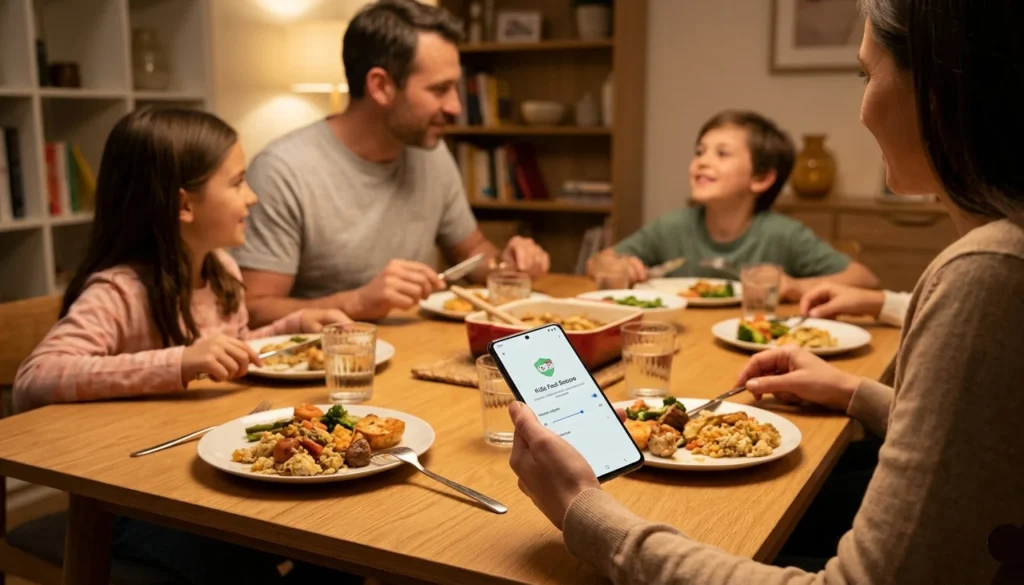
KIDS FEEL SECURE
Sometimes kids just need a nudge back to the real world
Even the best conversations don’t always work in the moment. Kids Feel Secure gives parents a simple way to quietly bring their child back to the present — without a battle.
- Remote volume control — turn down or silence your child’s device from your phone, instantly
- Perfect for homework time, family meals, or bedtime wind-down
- Works discreetly in the background — a nudge, not a punishment
- Part of a broader toolkit designed to help parents guide, not just restrict
Learn more about Kids Feel Secure →
Leave a Reply