
Executive Summary
- Over 1 billion young people worldwide are at risk of permanent hearing loss from unsafe listening—and speakers are a major, overlooked contributor.[1][2]
- Children turn up the volume because their brains reward loud stimulation, they struggle to filter background noise, and they have no frame of reference for “too loud”.[3][4][5]
- 12.5% of children aged 6–19 already have permanent noise-induced hearing damage—damage that is gradual, painless, and irreversible.[6][7]
- Kids Feel Secure—Volume Control lets parents remotely set a hard speaker volume limit on their child’s device, protecting hearing and building healthier device habits over time.
- Combining tech-based limits with conversations about hearing health and modelling good volume behaviour gives kids the best chance of self-regulating as they grow.
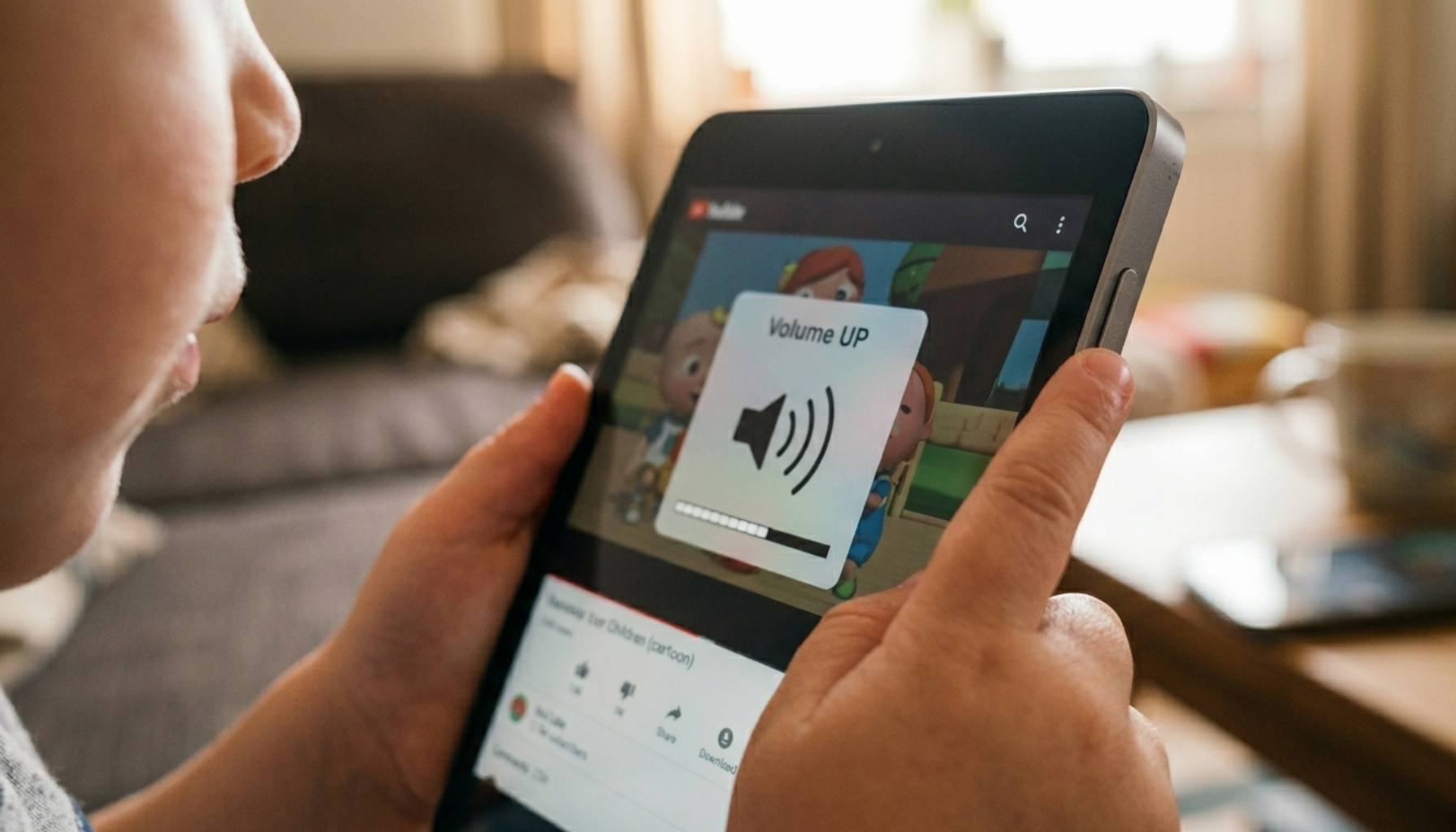
If you’ve ever walked into the living room and been hit by a wall of sound from your child’s tablet, you’re not alone. Kids don’t just like things loud—there are real psychological and developmental reasons they crank the speaker to full blast. Unfortunately, what feels exciting to them can quietly cause permanent damage to their hearing.[5][7][3]
Let’s unpack why children are drawn to high volume, what the science says about the risks, and what parents can actually do about it—without starting a daily battle over the phone.
It’s Not Defiance—It’s How Their Brains Work
When a child turns up the speaker on a tablet, TV, or Bluetooth speaker, they’re usually not trying to annoy you. Young brains are wired to seek stimulation. Loud sounds can trigger a dopamine response—the same reward chemical released by sugar, games, and social media notifications. Volume becomes a shortcut to feeling more engaged, more entertained, more alive.[4]
There’s also a focus factor at play. Children have not fully developed the ability to filter background noise, often referred to as the “cocktail party effect”. In a household with conversations, appliances, and siblings, cranking the volume is their solution to hearing clearly. It’s instinctive, not intentional.[8][5]
Add to this the simple fact that kids lack context for “too loud.” Adults have years of experience with volume norms. A six-year-old watching cartoons through a speaker has none of that calibration. If it sounds exciting, it must be the right level.
The Numbers Are Alarming
The World Health Organization estimates that over 1 billion young people are at risk of permanent, avoidable hearing loss due to unsafe listening practices. That’s not a future projection—it’s the current situation.[2][1]
According to the American Academy of Pediatrics, a significant percentage of adolescents and young adults regularly exceed the maximum recommended daily noise dose, especially when background noise is present—which is exactly the scenario when a kid turns up a tablet speaker in a noisy room. The CDC’s threshold sits at 85 decibels sustained over eight hours, though health experts note this standard was designed for adults in workplaces, not children at home.[9][6]
A study published in the Journal of Pediatrics found that 12.5% of children aged 6–19 already have permanent hearing damage from noise exposure. One in eight kids. And most of that damage is entirely preventable.[7][6]
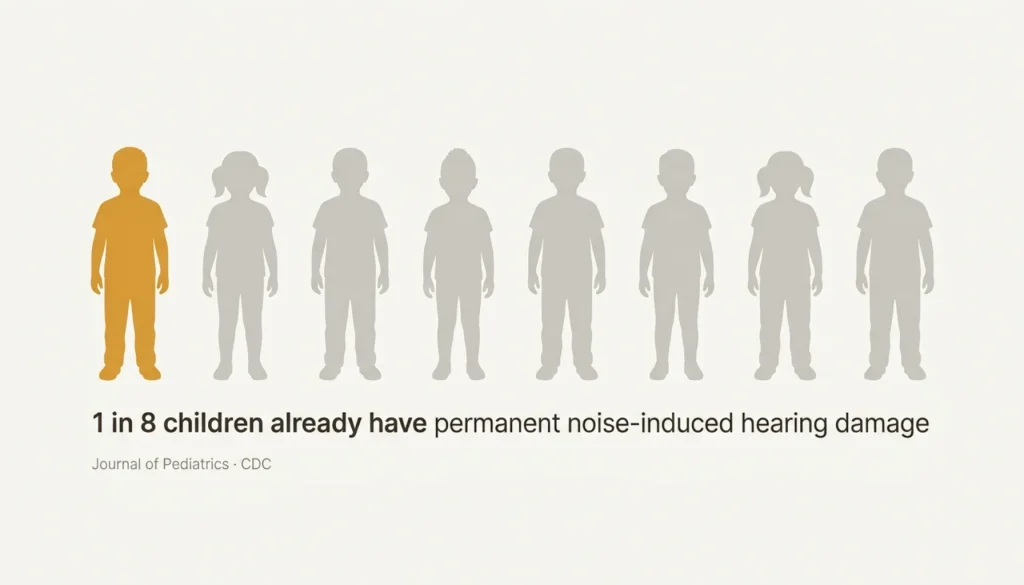
Here’s the part that catches parents off guard: hearing loss from noise is gradual and painless. There’s no single moment where you notice it happening. By the time symptoms show up—ringing ears, difficulty following conversations in noisy rooms—the damage is already done. The hair cells in the inner ear that convert sound into nerve signals don’t regenerate.[7]
Speakers Aren’t Safer by Default
A lot of the conversation around kids and volume focuses on headphones, but speakers carry their own risks. A tablet or phone at max speaker volume can easily push past 90–100 dB. A Bluetooth speaker can go even higher. And unlike headphones, speakers affect the whole room—meaning prolonged exposure at high levels can impact everyone, including younger siblings and toddlers who have no say in the matter.[9]
There’s also a behavioural pattern worth noting: kids using speakers tend to keep volume high for longer sessions because it’s ambient. With headphones, there’s at least a chance a parent walking by will notice the tinny sound leaking out. With a speaker blasting in a bedroom behind a closed door, the exposure can go on for hours unnoticed.
The Habit Problem
Volume isn’t just a hearing issue—it’s a device habit issue. When kids learn early that louder equals better, it shapes how they interact with technology for years. They become desensitised to moderate volume. They default to max. They resist any attempt to turn it down because it feels like something is being taken away.
This is the same pattern we see with screen brightness, notification sounds, and screen time itself. Without guardrails set early, the default drifts upward. And by the time a child is a teenager, the habit is deeply embedded.
The solution isn’t to ban speakers or confiscate devices. It’s to set sensible limits that kids can internalise over time—so they eventually self-regulate, the same way they learn to manage screen time or bedtime.
Setting Volume Limits Without the Daily Fight
This is where most parents hit a wall. You can tell a child to turn it down ten times a day, or you can set a limit that does the work for you.
Kids Feel Secure—Volume Control lets parents remotely set a maximum speaker volume on their child’s device. Not a suggestion. Not a one-time setting the child can override. A hard ceiling that stays in place, managed from the parent’s phone.
The child can still adjust volume freely within that range. They keep their sense of control. But they can’t push into the danger zone—whether they’re watching videos, playing games, or streaming music through the device’s speaker.
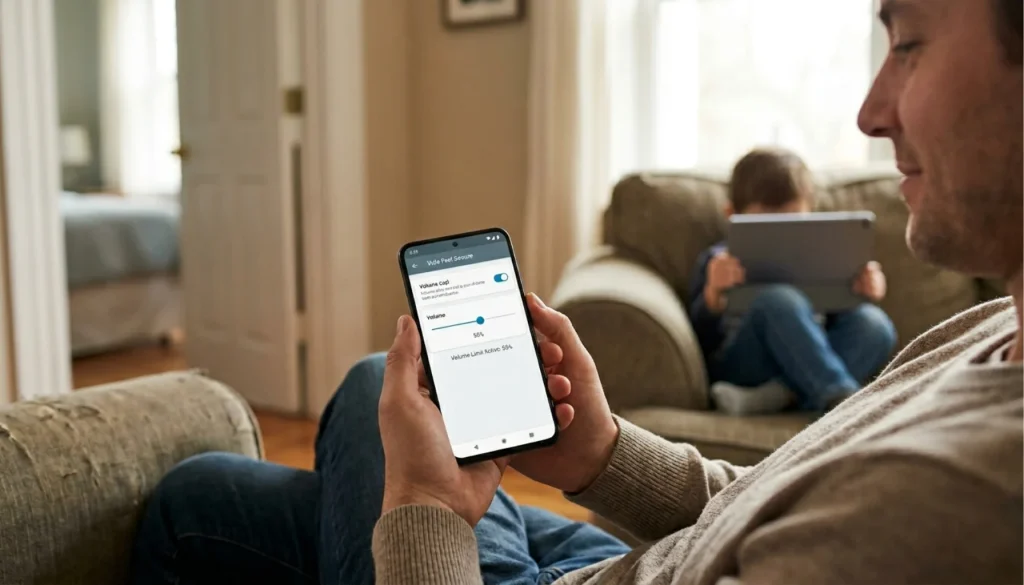
Over time, this does something more important than just protecting hearing. It teaches better device habits. Kids who grow up with reasonable volume limits develop a healthier baseline. They learn that entertainment doesn’t require maximum sensory input. That’s a skill that carries over into how they manage screens, notifications, and digital stimulation in general.
And because it’s set remotely, there’s no negotiation. No “just a little louder.” No resetting it when you leave the room. The limit is the limit.
What Else Parents Can Do
Technology-based limits like Kids Feel Secure handle the enforcement side. But there are a few complementary habits worth building:
- Talk about why volume matters. Kids respond better to reasons than rules. Explain that loud sounds can hurt the tiny parts inside their ears that don’t grow back.[7]
- Model good volume behaviour yourself. If the TV is always blasting during dinner, the message is mixed.
- Create quiet zones or quiet hours in the home. Normalise lower volume as the default, not the exception.
- Pay attention to early warning signs like your child asking “what?” frequently, turning their head to hear, or complaining about ringing in their ears.[7]
The Bottom Line
Kids turn up the volume because their brains reward it, their ears don’t warn them, and nobody has given them a reason to stop. It’s not bad behaviour—it’s a gap in guidance and guardrails.[3][4][7]
The research is clear: noise-induced hearing loss in children is rising, it’s preventable, and speakers are part of the equation. A tool like Kids Feel Secure—Volume Control gives parents a practical, low-friction way to protect their child’s hearing and build healthier device habits from the start.[6][7]
Because by the time your child notices the damage, it’s already permanent. The best time to set the limit is before they need it.[7]
⁂
- https://www.who.int/news/item/12-02-2019-new-who-itu-standard-aims-to-prevent-hearing-loss-among-1.1-billion-young-people
- https://news.un.org/en/story/2022/03/1113182
- https://www.sciencedaily.com/releases/2019/02/190211131535.htm
- https://pmc.ncbi.nlm.nih.gov/articles/PMC7043886/
- https://www.aalto.fi/en/news/brain-recordings-show-that-background-noise-strongly-impairs-childrens-ability-to-concentrate
- https://restoredcdc.org/www.cdc.gov/hearing-loss-children/about/preventing-noise-induced-hearing-loss.html
- https://medicalxpress.com/news/2014-02-percent-children-ages-noise-induced.html
- https://www.eurekalert.org/news-releases/692472
- https://bollsen-hearingprotection.com/blog/what-noise-level-is-safe-for-kids/
- https://pubmed.ncbi.nlm.nih.gov/26200926/
- https://www.sciencedirect.com/science/article/pii/S0006899325001489
- https://www.audiology.org/effect-of-speech-in-noise-training-on-the-auditory-and-cognitive-skills-of-children-with-auditory-processing-disorders/
- https://discovery.ucl.ac.uk/id/eprint/1476657/
- https://pubmed.ncbi.nlm.nih.gov/40120707/
- https://pubmed.ncbi.nlm.nih.gov/40541085/
- https://www.youtube.com/watch?v=uMOjZwjJ0xM
- https://journals.sagepub.com/doi/10.1177/00139165241245823
- https://happysensitivekids.com/2016/11/how-do-you-make-the-world-a-little-quieter-for-a-highly-sensitive-child/
- https://massivesci.com/notes/auditory-processing-speech-background-noise/
- https://pmc.ncbi.nlm.nih.gov/articles/PMC4337492/
- https://www.academia.edu/47216481/Speech_Processing_to_Improve_the_Perception_of_Speech_in_Background_Noise_for_Children_With_Auditory_Processing_Disorder_and_Typically_Developing_Peers
- https://acousticstoday.org/wp-content/uploads/2019/03/Too-Young-for-the-Cocktail-Party-Lori-J.-Leibold.pdf
Leave a Reply